Makam Pitches: Theory, Practice and the Ear
How many pitches does Turkish makam music really use in one octave, which ones can its official notation write, and how does it compare with other music systems and with what the ear can hear?
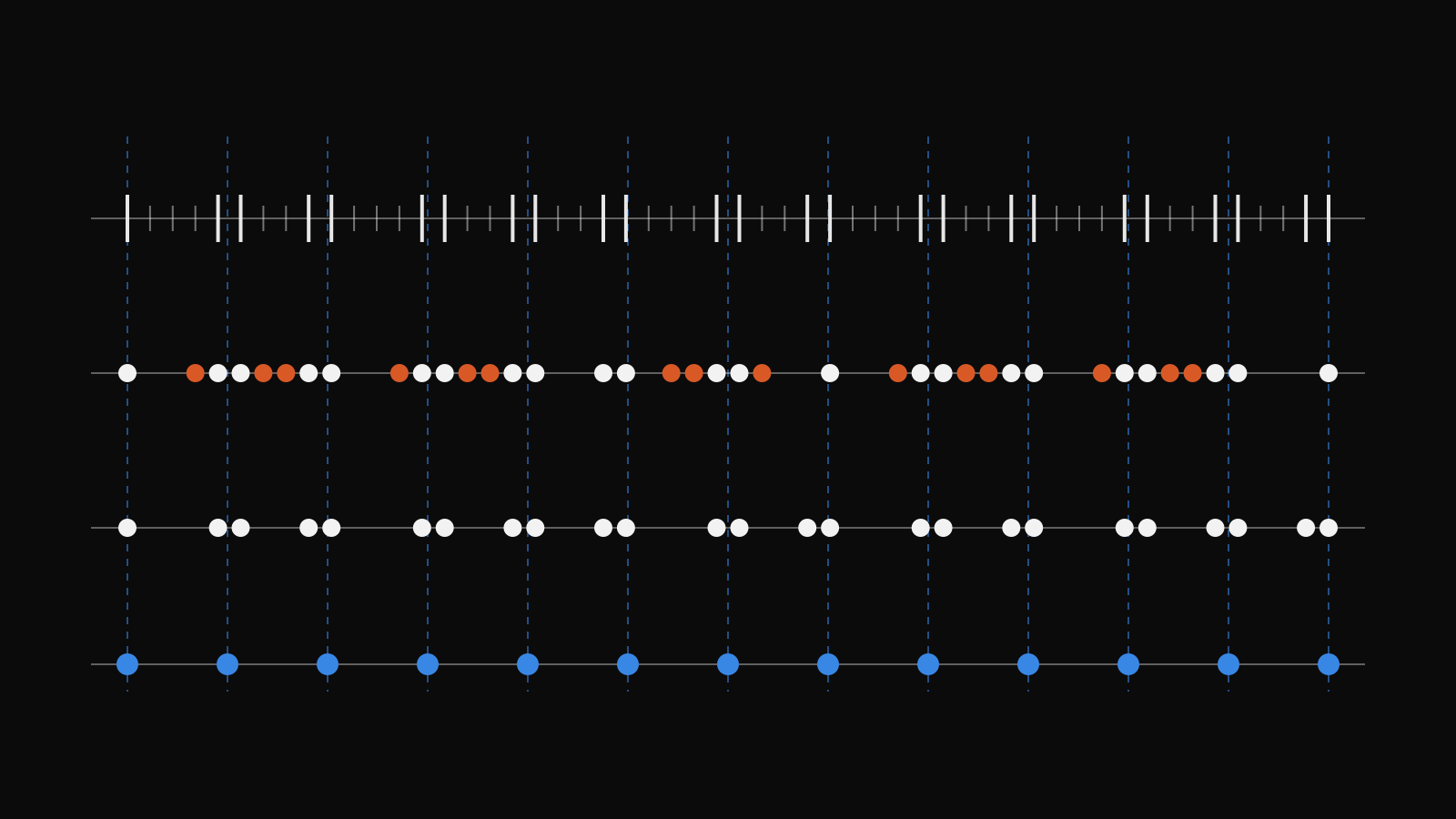
Turkish makam music has one of the most finely detailed pitch systems among the world’s traditional musics. So what does it actually look like? Can we see where its microtonal notes fall inside one octave, and compare them with Western music and with other microtonal systems?
I’m a music technology student. I’m Turkish, but I never had a Turkish classical music education, and this has been one of the things I have wondered about most: how many different pitches are really used, and how many of them can be written down?
Before I looked into it, I believed three things that turned out to be wrong:
- “A whole tone is divided into 9 equal pieces.” Only half true, as we’ll see.
- “The sharps and flats differ only by amounts nobody can hear.” In most of the range, they can be heard.
- “The system taught in school can represent all of Turkish music.” It can’t.
In this post you’ll find:
- how the Turkish notation systems divide the octave, and which pitches musicians actually use;
- what the academic system (AEU) is, how close it is to the 53-tone system, and where it falls short;
- the 53 Holder koması system itself, and how its smallest step compares with what the human ear can detect;
- the pitch sets of a few makams, the source of their different flavours and characters;
- Turkish music next to other pitch systems of the world, all on the same ruler;
- Happy Birthday in G major and in Rast, to hear how well the Turkish system can play a Western tune.
All figures are interactive: click or tap any note to hear it.
Turkish pitch systems and the pitches actually used
Turkish music theory measures pitch in commas (koma). One comma is about 22.6 cents, where a cent is 1/100 of a Western semitone; 1200 cents make an octave. Cents are logarithmic, so equal steps in cents sound like equal steps to the ear, even though in Hz the same step gets bigger as you go up.
The academic standard is the Arel-Ezgi-Uzdilek (AEU) system, named after the three theorists who shaped it in the first half of the 20th century: Hüseyin Sadettin Arel, Suphi Ezgi and Salih Murat Uzdilek. It is the system of conservatories and printed scores. AEU builds 24 pitches per octave by stacking pure fifths (frequency ratio 3/2), and names them: Rast, Dügâh, Segâh, Çârgâh and so on.
AEU turns out to be almost identical to a simpler system, the 53-tone equal division of the octave (more on it below): every AEU pitch lies less than 1 cent from one of its 53 steps. But 24 pitches are not enough. In several makams, musicians play pitches AEU has no symbol for, and that information is passed on by ear, from teacher to student, in the oral tradition called meşk. Several alternative systems have been proposed to close the gap (for example Ekrem Karadeniz’s 41-tone and Ozan Yarman’s 79-tone systems), but none of them is in common use.
Music information retrieval (MIR) research usually works on the 53-tone grid instead. It can hold the pitches outside AEU, and because its steps are equal, it is easy to transpose, to generate digitally and to measure against.
That’s also how we can see what musicians really play. SymbTr, a corpus of Turkish makam scores built for MIR research by M. Kemal Karaosmanoğlu (2012), stores two values for every note: its AEU spelling, and the pitch an expert says it is actually played at on the 53-tone grid. The current version has 2,200 pieces in 155 makams, 849,403 notes in total. 7.7% of those notes are played off the AEU grid, almost always by exactly one comma. Counting every position that is used in at least 10% of some makam’s pieces, practice uses 37 pitches, not 24: 22 of the AEU pitches plus 15 that AEU can’t write. (Two AEU pitches, Dik Hicaz and Dik Mâhur, are practically never used.)
The difference isn’t a matter of key. The same written note is played at different heights in different makams. Written Segâh is played at comma 17 in Rast but one comma lower, at comma 16, in Uşşak, Bayati, Hüseynî and Saba. The score is the same; the pitch depends on the makam, and on the tradition that tells you which one to play.
Figure 1 · Three ways to cut the octave, plus what musicians actually play
53 Holder koması · 53 equal steps, 1 comma ≈ 22.64 cents
Practice (SymbTr) · 37 pitches
AEU · 24 pitches from stacked pure fifths
Western 12-TET · 12 equal steps of 100 cents
- Used in practice, not in AEU
- 12-TET position
- Dot colour = row
Click or tap a note to hear it · Shift-click plays the row · Keyboard: Tab to a row, ←/→ to move, Enter to play
Bottom to top: Western 12-TET, the 24 AEU pitches, the 37 pitches used in practice (from SymbTr) and the 53 Holder koması grid. Diamonds are pitches musicians use that AEU can’t write. Notes are labelled with Karaosmanoğlu’s codes: a letter plus the number of commas above (♯) or below (♭) it, so B♭2 is two commas below B. Rast is placed on Sol (G4) = 392 Hz; in Turkish practice the absolute pitch depends on the ahenk (transposition level), but the cents stay the same.
AEU: how close it is to the 53-tone system, and where it falls short
AEU is built from pure fifths, the 53-tone system from equal steps, so strictly they are two different systems. In practice the difference doesn’t matter: every AEU pitch lies within 0.9 cents of a 53-tone step (the largest gap is Dik Bûselik, 0.88 cents). That is far below anything the ear can detect, so AEU can be treated as 24 of the 53 points.
Between neighbouring AEU pitches there are only three step sizes: 1, 3 or 4 commas (about 23.5, 66.8 and 90.2 cents). And against the piano, apart from Rast itself, no AEU pitch equals a 12-TET note. Every white key has an AEU pitch within 8 cents. Three of the black keys, G♯, C♯ and F♯, fall between two AEU pitches about 10 to 14 cents away on either side; A♯ and D♯ each have one about 6 to 8 cents away.
AEU’s weak points come from that fixed set of 24:
- Missing pitches. The 15 practical pitches above have no symbol, so the score shows a nearby AEU note and the player is expected to know better.
- One symbol, several pitches. Written Segâh sounds at comma 17 in Rast and at comma 16 in Uşşak. Hüzzam plays written Eviç one comma lower, and Saba plays written Hicaz one comma higher.
- Unused symbols. Dik Hicaz and Dik Mâhur are part of the system but barely appear in real music.
The 53 Holder koması system
The 53-tone system divides the octave into 53 equal steps of 1200/53 ≈ 22.64 cents. In Turkish theory this step is called the Holder koması (Holdrian comma), after the English theorist William Holder, who described it in the 17th century; the mathematician Nicholas Mercator had worked out the division before him. Its trick is that 31 of its steps make a fifth only 0.07 cents away from a pure 3/2, which is why it fits a fifth-based system like AEU so well.
This is where my first misunderstanding comes from. On this grid a whole tone is 9 commas, so “the whole tone is divided into 9” is true for the grid. But AEU names only 4 of the 8 positions inside a whole tone (1, 4, 5 and 8 commas above the lower note), and in practice musicians use a few more of them. A Western semitone also isn’t 4.5 commas: the two “semitones” of this system are 4 and 5 commas.
Makams: different flavours from different pitches
A makam is a melodic mode. It is a set of pitches plus rules about which notes to stress, how a melody travels through them and where it comes to rest. The final note is called the durak. Two makams can share most of their notes and still sound very different, because one or two pitches sit a comma higher or lower, or because the melody moves through them differently.
The figure below shows a few makams side by side with C major. Rast and Çârgâh are the theory versions. The four lower rows come from the SymbTr data: every pitch that makes up at least 2.5% of that makam’s notes, folded into one octave.
Figure 2 · Makams and keys on the 53-grid
Hüzzam · 96 pieces
Saba · 66 pieces
Hüseynî · 92 pieces
Uşşak · 118 pieces
Rast makam · theory
Çârgâh makam · the makam closest to C major
C major · Western, 12-TET
- Not in AEU (Karaosmanoğlu code)
- 12-TET position
- Dot colour = row
Click or tap a note to hear it · Shift-click plays the row · Keyboard: Tab to a row, ←/→ to move, Enter to play
C major and Çârgâh look alike, but Rast’s third (Segâh) is about 15 cents below B and its seventh (Eviç) about 13 cents below F♯. Notice comma 16 (B♭2) in Uşşak, Hüseynî and Saba where Rast has 17. Hover over a note to see its share of the makam’s notes.
Some recordings to hear these makams in real music:
- Rast: listen on YouTube
- Hüzzam: example 1, example 2
- Saba: listen on YouTube
- Uşşak: listen on YouTube
Turkish music next to other pitch systems
Here are some other pitch systems of the world on the same ruler, all starting from Sol = 392 Hz. Only the possible notes of each system are shown, not scales.
Figure 3 · How musical cultures cut the octave (coarse at the bottom, fine at the top)
53 Holder koması · Turkish 53-tone system (53-TET)
Turkish practice · SymbTr, 37 pitches
Arabic & Persian · 24-EDO quarter tones (theory)
Indian 22 śruti · Sa = G, one common just list
Chinese 12 lü · chain of fifths from huangzhong = G
Western · 12-TET
Thai · 7-EDO, idealized
Javanese pelog · average of measured gamelans
Javanese slendro · 5-EDO, idealized
- Turkish practice: not in AEU
- 12-TET position
- Dot colour = row
Click or tap a note to hear it · Shift-click plays the row · Keyboard: Tab to a row, ←/→ to move, Enter to play
Slendro, pelog and Thai tunings are idealized or averaged; real instruments vary. Arabic and Persian theory has used 24 quarter tones since the 1932 Cairo Congress (and Vaziri), but practice uses neutral intervals that deviate from them. The Chinese chain of fifths doesn’t close: Zhonglü ends up about 24 cents above a pure fourth. The śruti list is one common just-intonation version; sources differ.
The biggest surprise for me was how close the Indian śruti list is to AEU. Both are built mostly from the same pure ratios: 13 of the 23 śruti pitches are exactly AEU pitches, and 9 more are within 2 cents of one. The Chinese twelve lü are built exactly like AEU, by stacking pure fifths, so their shared pitches line up exactly (Dalü is Zirgüle, Taicu is Dügâh).
Arabic and Turkish music are often described as close relatives, but on paper their pitch systems don’t match well. The 24 quarter tones fall on AEU pitches only at a few points (Rast, Çârgâh, Nevâ and the octave). The characteristic in-between quarter tones, like 150 or 350 cents, are 25 to 44 cents away from any AEU pitch. Real Arabic practice uses neutral intervals that bend away from the quarter-tone grid, so the sounding difference is smaller than the theory suggests. The Javanese gamelan tunings and the Thai scale don’t sit on the Western grid at all: they are a different way of dividing the octave, not a slightly detuned version of ours.
Happy Birthday in G major and in Rast
How well can the Turkish system play a Western tune? Here is Happy Birthday (public domain, from “Good Morning to All”, 1893) in G major, tuned in 12-TET, and in Rast, the makam usually compared with the major scale. In the Rast version every note comes from the 53 Holder koması grid, and only Rast itself (G) is shared with 12-TET.
Two notes clearly change: B becomes Segâh, about 15 cents lower, and F♯ becomes Eviç, about 13 cents lower. The others (Dügâh, Çârgâh, Nevâ, Hüseynî) are only 2 to 6 cents away from their Western neighbours, so you may not hear any difference there. Play it at G4 first, then switch to the lower registers and listen to the difference shrink.
Happy Birthday in two tunings
Can the ear even hear one comma?
My second misunderstanding was that these comma differences are too small to hear. The ear’s pitch resolution is measured as the just noticeable difference (JND), the smallest change we can detect, and it isn’t fixed. One comma is always about 1.32% of the frequency; the JND in Hz is roughly flat in the bass and grows with frequency.
Between 500 Hz and 4 kHz, one comma is about 2 to 7 times the JND, depending on the data set: clearly audible for an attentive ear. In the bass the margin disappears. With the values from my music perception course, one comma drops below the JND under about 225 Hz, which is G3 and the whole range of a bass line. The more sensitive data of Wier, Jesteadt and Green (1977) are more forgiving, but the margin still shrinks there. And these are best-case numbers with long, steady tones; short notes make it harder still (more on that in my next post, about bass, note duration and pitch detection).
Figure 4 · One comma vs. the smallest pitch change the ear notices
- One comma (1.32% of f)
- JND, course slide 11
- JND, Wier et al. (1977)
- One comma below the JND
My own chart of the two JND data sets (not the textbook figure). The shaded strip is where one comma is smaller than the JND. The buttons play a note and then the same note one comma higher, so you can hear the difference get harder to catch as you go down.
Sources
- Karaosmanoğlu, M. K. (2012). A Turkish makam music symbolic database for music information retrieval: SymbTr. Proceedings of ISMIR 2012, pp. 223–228.
- SymbTr repository: github.com/MTG/SymbTr (CC BY-NC-SA 4.0; this post only publishes statistics derived from it).
- Bozkurt, B., Yarman, O., Karaosmanoğlu, M. K., & Akkoç, C. (2009). Weighing diverse theoretical models on Turkish maqam music against pitch measurements. Journal of New Music Research, 38(1).
- Wier, C. C., Jesteadt, W., & Green, D. M. (1977). Frequency discrimination as a function of frequency and sensation level. Data via my music perception course slides.
- Shruti (music), Wikipedia.
- Gamelan pelog and slendro averages: preinfarction.blogspot.com.