Neural Synthesizer Sound Matching with Sequential Frame-Prediction Networks
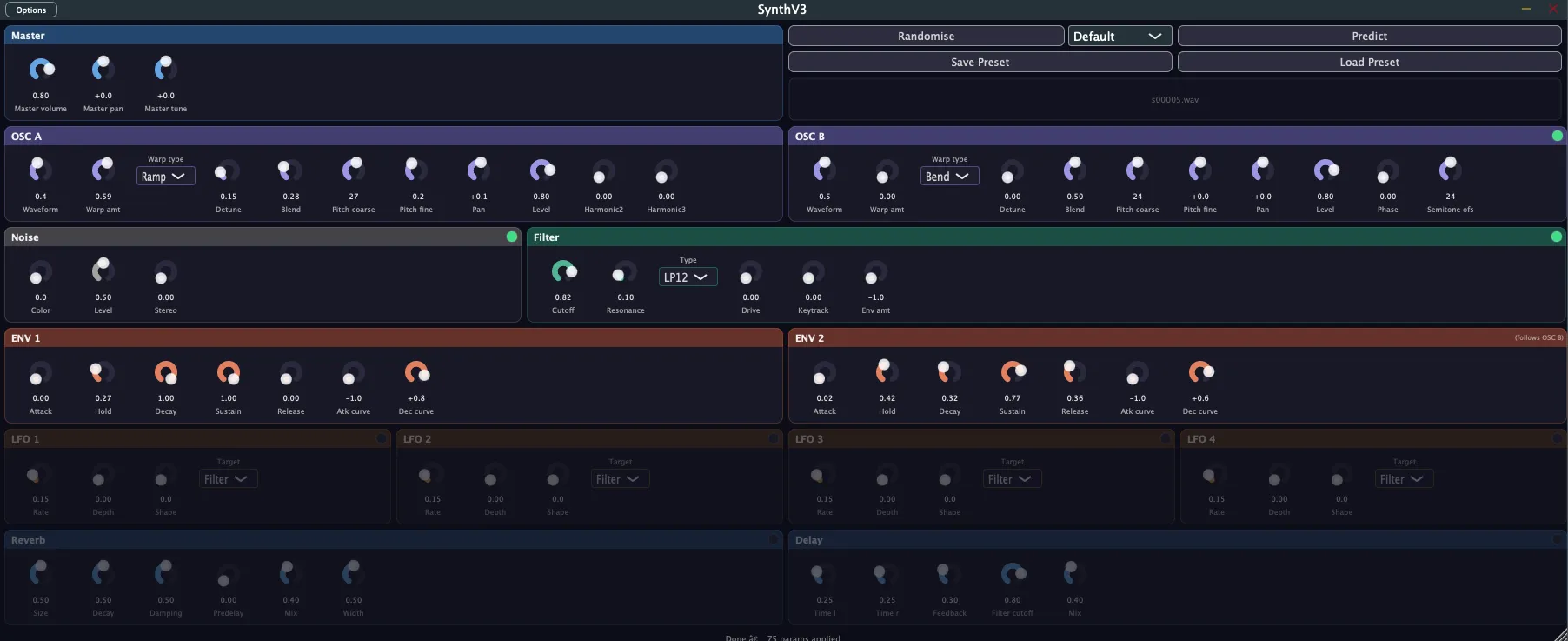
Overview
Given a short audio clip, this system predicts the full set of synthesizer parameters needed to recreate it — recovering a sound from audio alone. The model runs in real time inside a VST plugin, so sound designers can drop in a target sample and get a playable patch back.
The synthesizer
Everything is built around a custom polyphonic synthesizer written in C++ with JUCE, exposing 70 parameters across oscillators, filters, envelopes and effects. Owning the synth end to end made it possible to generate unlimited, perfectly labeled training data.
Architecture
The model uses sequential frame-prediction: instead of one network guessing every parameter at once, specialized CNNs follow the synth’s audio signal chain, each predicting the parameters of one stage. A module-detecting classifier runs first and gates which specialized networks are used, so the system only predicts parameters for modules that are actually audible.
Training
The targets are a mix of continuous values (cutoff, envelope times, levels) and categorical choices (waveforms, filter types). Networks are trained on mel-spectrograms with a combined loss: mean squared error for continuous parameters and cross-entropy for categorical ones.
Real-time inference
Trained models are exported to ONNX and run inside the VST plugin through ONNX Runtime, giving real-time predictions directly in the user’s DAW.
Pipeline
The whole workflow — dataset generation, training and export — is a config-driven Python/PyTorch pipeline. A new version of the synthesizer can be supported with zero code changes, just a new config file.